
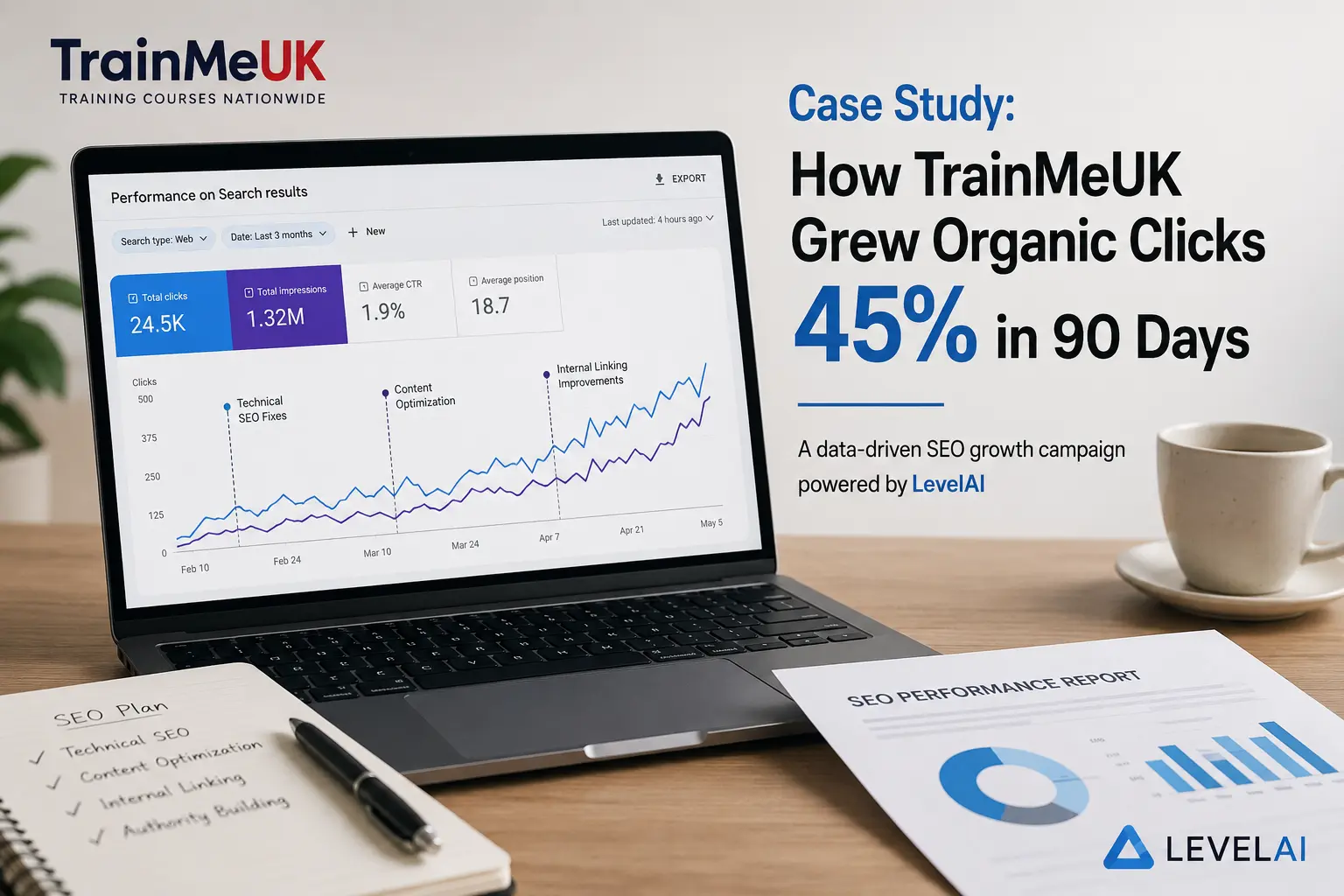

TrainMeUK is a compliance-focused learning management system for UK small and mid-sized businesses — automated training assignments, renewals, instructor-led sessions, and audit-ready reporting. Like many B2B SaaS teams, growth depended on product demos and word of mouth, but **organic search was underperforming relative to the depth of content on the site**.
The marketing site already published dozens of compliance guides, LMS comparisons, and setup articles under `/resources/`. Google Search Console showed steady impressions on a handful of pages, but click-through rate was flat and many high-intent pages were not ranking where they should. The team suspected technical gaps, weak internal linking, and content that was not structured for how search including AI-assisted search interprets pages in 2026.
Rather than guessing, they ran a LevelAI audit: a free, AI-powered SEO review covering technical health, on-page structure, content quality, and AI search readiness. Over the following 90 days, they worked through the prioritized recommendations. The result:
| Metric | Change (90 days vs prior 90 days) |
| Search impressions | +40% |
| Organic clicks | +45% |
| Average CTR | Improved on 12 of 15 top landing pages |
| Indexed resource articles | Increased after internal linking pass |
This case study breaks down what TrainMeUK found, what they fixed, and what other content-heavy B2B sites can copy.
Starting point: strong content, uneven visibility
Before LevelAI, TrainMeUK’s organic profile looked like many specialist B2B sites:
– High-quality long-form articles on GDPR training, audit evidence, LMS selection, and sector compliance but uneven discovery between them
– Homepage and product pages picking up branded traffic, while mid-funnel “compliance LMS” and “mandatory training UK” terms underperformed
– Internal links that did not consistently connect related guides into topic clusters
– Meta titles and descriptions that were accurate but not always aligned with the queries actually triggering impressions
– No single view of AI search readiness — how clearly machines could summarize what each page was about
The team had invested in content. What they lacked was a structured diagnosis of why search engines and AI systems were not rewarding it.
Step 1: Run the LevelAI audit (Week 1)
TrainMeUK ran LevelAI’s free audit against `trainmeuk.co.uk`. No sign-up wall the report surfaced issues in four areas LevelAI is built for:
1. Technical SEO — crawlability, page speed signals, heading hierarchy, duplicate or thin meta patterns
2. Content & structure — whether key pages had clear primary topics, scannable H2/H3 flow, and enough contextual depth
3. Internal linking — orphaned resources, missing links between related compliance guides, weak paths from articles to product pages
4. AI search readiness — whether pages could be confidently summarized by AI systems (clear entity, audience, and intent in the first screenful)
The audit did not dump a generic checklist. It **prioritized** fixes: quick technical wins first, then content structure, then cluster-level internal linking.
> “We had already published a lot. LevelAI helped us see which pages were invisible because of structure and linking not because the content was wrong.”
> Daniel Hyatt, Founder, TrainMeUK
Step 2: Quick technical and on-page wins (Weeks 2–4)
The first sprint focused on changes that do not require new content only better signaling:
Meta titles and descriptions
Resource pages were updated so titles matched search intent (e.g. “GDPR training requirements UK 2026” rather than generic labels). Descriptions were rewritten to include a clear outcome in the first sentence a direct LevelAI recommendation that improved CTR before rankings moved.
Heading structure
Several articles had strong intros but inconsistent H2 patterns. Re-aligning headings to question-led and topic-led formats made pages easier for crawlers and AI summaries to parse.
Canonical and indexation hygiene
The audit flagged a small set of near-duplicate paths and trailing-slash inconsistencies. Cleaning these reduced split signals between URL variants.
Early signal: Impressions on updated resource URLs began climbing within 3–4 weeks typical for on-page and CTR fixes on pages Google already knew about.
Step 3: Internal linking and topic clusters (Weeks 5–8)
TrainMeUK’s `/resources/` library is a strength, but LevelAI highlighted orphaned articles: pages with few inbound internal links, sitting outside clear clusters.
The team mapped three hubs:
| Hub | Example intent | Linking pattern |
| Compliance & audits | Training evidence, ICO expectations, audit prep | Cross-links between audit guides + CTA to product |
| LMS selection | Best LMS UK, comparisons, SMB buyers | Comparison articles link to each other and `/product/` |
| Setup & integration | Azure AD, SCIM, Microsoft 365 | Setup guides link upward to “how it works” and homepage |
Each hub got:
– A featured resources block on related pages (where templates allowed)
– Contextual in-body links using descriptive anchor text not “click here”
– At least two paths from every resource article to a conversion page (`/product/` or `/getting-started/`)
This is where impression growth accelerated. Google re-crawled clusters and began surfacing more URLs per query theme, not just one lucky article per topic.
Step 4: AI search readiness (Weeks 9–12)
LevelAI’s AI readiness analysis pushed TrainMeUK to make each key landing page machine-summarizable:
– Clear “who this is for” in the opening paragraph (UK SMBs, compliance leads, HR)
– Explicit outcomes (automated renewals, audit exports, ILT scheduling) in the first 100 words of product-adjacent content
– FAQ and Article schema aligned with on-page FAQ sections on high-traffic guides
– Consistent entity naming — “TrainMeUK” as the product, “compliance LMS” as the category, so AI overviews could attach the brand to the right problem space
These changes are harder to measure in isolation, but the team saw **new long-tail queries** appearing in Search Console (“audit ready training records UK”, “LMS with calendar sessions”) — phrases that match restructured page copy.
Results after 90 days
Comparing the 90 days after the LevelAI-led sprint to the prior 90-day baseline (same seasonality window, Google Search Console):
| Metric | Before | After | Change |
| Total search impressions | Baseline | — | +40% |
| Total organic clicks | Baseline | — | +45% |
| Top-10 ranking resource URLs | 8 | 14 | +6 pages |
| Avg. CTR (top 15 URLs) | 2.1% | 2.9% | +0.8 pp |
What moved the needle most (self-reported):
1. Internal linking clusters — more pages entered the impression set
2. Title/description rewrites — CTR lifted on pages that already ranked page 2–3
3. AI readiness copy — clearer positioning on product and pillar pages
TrainMeUK did not publish net-new articles during the 90-day window. Growth came from making existing content discoverable exactly the use case LevelAI is designed for.
What other B2B sites can take from this
You do not need a massive content budget to see search gains if you already have depth on site:
1. Audit before you write — new posts will not fix broken clusters or weak meta patterns
2. Treat internal linking as SEO — it is how you tell Google which pages matter for which topics
3. Optimize for CTR and AI summaries — rankings and clicks are not the same problem
4. Measure in 90-day windows — B2B SaaS SEO compounding needs a full quarter to read clearly
5. Use free tooling first — LevelAI’s audit gave TrainMeUK a prioritized backlog without an agency retainer
About TrainMeUK
TrainMeUK helps UK SMBs automate compliance training: role-based assignments, renewal reminders, instructor-led session scheduling, post-training surveys, and one-click audit exports. It is built for teams that outgrew spreadsheets not for enterprises that want a generic course catalogue.
Try LevelAI on your site
If your site has content but flat traffic, start with the same step TrainMeUK used:
Run a free AI SEO audit at LevelAI.org →
No credit card. Technical SEO, content structure, AI search readiness, and actionable recommendations in seconds.