
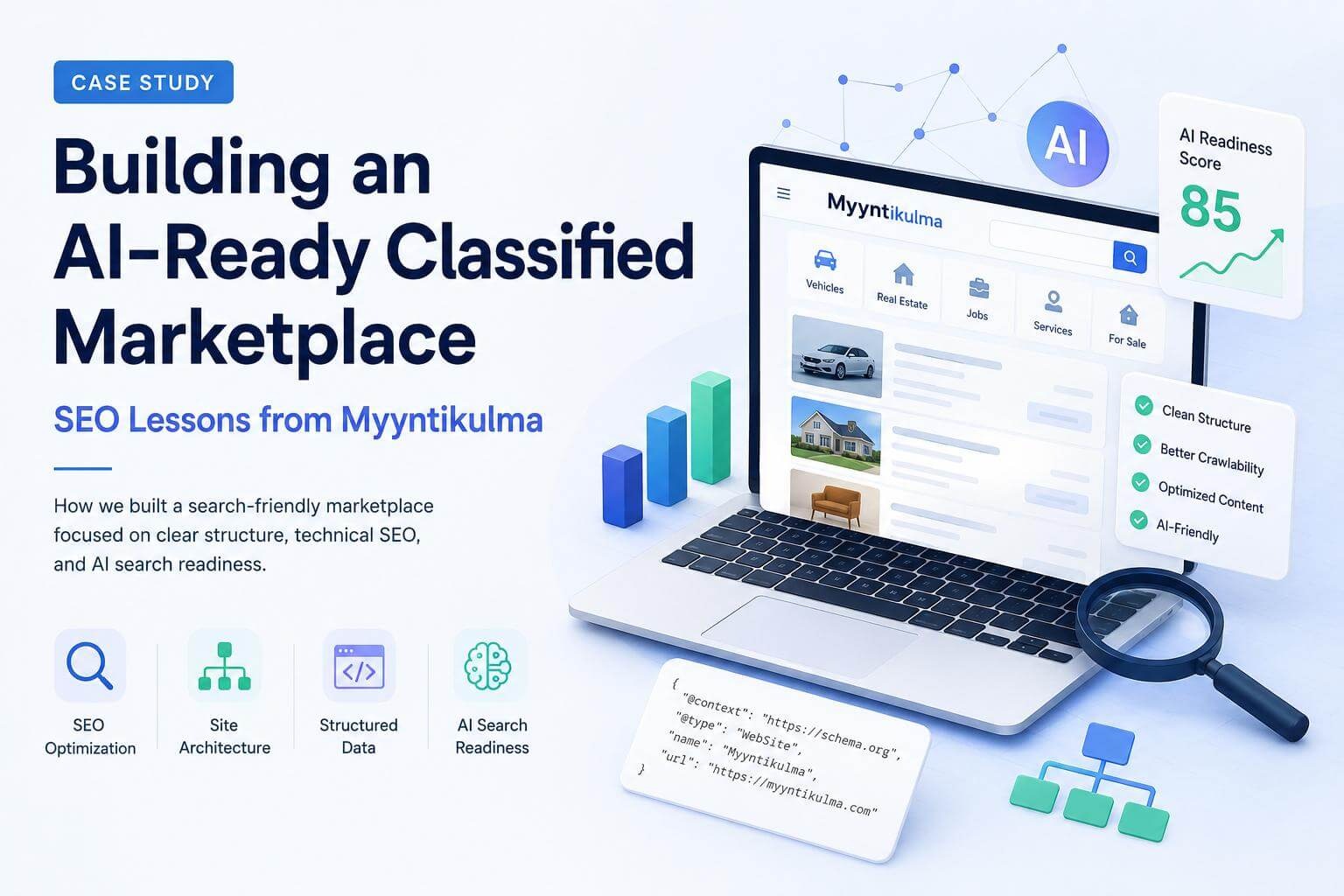

Building a classified marketplace is very different from launching a traditional business website or blog. While content-driven websites usually publish carefully crafted articles, marketplace platforms must manage thousands of user-generated listings, constantly changing inventory, category pages, and dynamic search results.
This creates unique SEO challenges that cannot always be solved by applying standard optimization checklists.
At Myyntikulma, our goal from the beginning was to build a marketplace that is not only easy for users to navigate but also easy for search engines and modern AI-powered search systems to understand.
As part of our ongoing optimization process, we evaluated our website using LevelAI to identify opportunities for improving content structure, crawlability, and AI search readiness.
This case study shares the SEO principles we’ve focused on while building Myyntikulma and explains why technical structure is becoming just as important as content quality.
Why Marketplace SEO Is Different
Marketplace websites face challenges that many standard websites never encounter.
Unlike a blog, where each article is carefully planned and maintained, classified marketplaces continuously receive new listings while older listings expire or become outdated.
Some of the biggest SEO challenges include:
- Large numbers of dynamic pages
- User-generated content
- Duplicate or similar listings
- Thin category pages
- Internal linking complexity
- Crawl budget management
- Constant changes in indexed pages
Without a solid site architecture, search engines can waste valuable crawl resources indexing pages that provide little value while missing pages that deserve visibility.
Building a Search-Friendly Foundation
Instead of focusing only on keywords, we prioritized building a strong technical foundation that helps both users and search engines understand the website.
Clean URL Structure
One of our priorities was keeping URLs short, descriptive, and organized around logical categories.
A predictable URL structure makes navigation easier while providing additional context for search engines.
Examples include category-based URLs that clearly indicate the content users can expect before clicking.
Logical Category Hierarchy
Marketplace websites often grow organically over time.
Without careful planning, categories quickly become confusing and difficult to crawl.
We invested time in organizing listings into a hierarchy that balances user experience with SEO.
A logical structure helps distribute authority throughout the site while improving discoverability of both categories and individual listings.
Internal Linking Strategy
Internal links remain one of the strongest signals available to search engines.
Instead of relying only on navigation menus, we created multiple opportunities for users and crawlers to discover relevant content naturally.
These include:
- Category navigation
- Related listings
- Breadcrumb navigation
- Contextual internal links
- Informational pages supporting marketplace categories
This improves crawl efficiency while encouraging visitors to explore additional content.
Optimizing for AI Search
Search behavior is evolving.
Modern search engines increasingly rely on artificial intelligence to summarize information, understand context, and identify relationships between pages instead of matching keywords alone.
For marketplace websites, this means structure matters more than ever.
Rather than creating pages solely for search engines, we focused on making every page understandable through:
- Clear heading hierarchy
- Descriptive page titles
- Helpful meta descriptions
- Well-organized content
- Semantic HTML
- Consistent navigation
These improvements make it easier for both traditional search engines and AI-powered search experiences to interpret page intent.
Technical SEO Priorities
Beyond visible content, technical optimization plays a significant role in marketplace performance.
Some of our ongoing priorities include:
Structured Data
Schema markup helps search engines better understand the website, its organization, navigation, and content.
Crawl Efficiency
Reducing unnecessary pages allows search engines to spend more time crawling valuable content.
Metadata
Every important page should have unique titles and descriptions that accurately reflect its purpose.
Mobile Performance
Since a large percentage of marketplace visitors browse on mobile devices, responsive design and fast loading times remain essential.
Using LevelAI to Evaluate Our Website
As part of our optimization process, we analyzed key pages using LevelAI.
Rather than expecting a single tool to solve every SEO challenge, we viewed the platform as an additional source of insight alongside our own technical reviews.
The analysis highlighted several areas worth monitoring, including:
- Content organization
- Heading consistency
- Readability
- Overall page clarity
- Opportunities to strengthen AI search readiness
The findings aligned with many of our existing optimization goals and helped reinforce the importance of maintaining a clean, structured website architecture as the platform continues to grow.
Lessons Learned
Building a marketplace isn’t only about publishing listings.
Long-term visibility depends on creating a website that search engines can efficiently crawl, understand, and trust.
Some of the biggest lessons from our experience include:
- Technical SEO should be considered from the very beginning.
- Internal linking deserves as much attention as content creation.
- Site architecture influences both rankings and user experience.
- AI-powered search rewards websites with clear organization and semantic structure.
- Regular website audits help uncover optimization opportunities before they become larger issues.
Looking Ahead
Search continues to evolve beyond traditional keyword matching.
As AI becomes a larger part of how users discover information, marketplaces must focus on clarity, structure, and accessibility rather than relying solely on content volume.
Our work on Myyntikulma is ongoing, and continuous analysis with tools like LevelAI helps us identify opportunities to improve both SEO performance and overall website quality.
While every marketplace faces unique challenges, the underlying principle remains the same: websites that are easy to understand are also easier to crawl, rank, and recommend.
Conclusion
Building an AI-ready marketplace is not about chasing algorithms, it’s about creating a website with a logical structure, high-quality organization, and a user-first experience.
For us, combining technical SEO best practices with continuous analysis has provided a solid foundation for long-term growth. As search evolves, maintaining a clean architecture and regularly reviewing site performance will remain central to our strategy.
Analyze Your Website with LevelAI
Whether you’re managing a blog, business website, or online marketplace, understanding how search engines and AI systems interpret your pages is becoming increasingly important. LevelAI provides a free website analysis covering technical SEO, content structure, and AI search readiness along with practical recommendations you can apply immediately.