

AI search ranking factors
Traditional search ranks documents for humans to inspect. AI search increasingly retrieves evidence for a model to synthesize into a committed answer. Google says AI Overviews and AI Mode may use “query fan-out” to issue multiple related searches and gather supporting pages. OpenAI says ChatGPT Search may rewrite a user’s prompt into multiple targeted queries and sometimes use third-party search providers. Microsoft described Bing’s Prometheus system as generating iterative internal queries through Bing Orchestrator, while Anthropic’s web search tool can search multiple times in a single request and always returns citations.
That matters because “ranking” in AI search is less about one exact keyword match and more about whether your page can survive decomposition into subquestions, passages, entities, products, local facts, and evidence snippets. Academic work reinforces this shift. RankRAG shows that context ranking is central to stronger retrieval-augmented answers; CRAG shows that systems perform better when they evaluate retrieval quality and expand to the wider web when initial evidence is weak; Self-RAG improves factuality and citation accuracy by retrieving only when needed and critiquing the generated output against evidence.
The most defensible synthesis of current ranking signals is shown below:
| System | Official discovery path | Signals most likely to matter in practice | Key controls |
|---|---|---|---|
| ChatGPT Search | OpenAI’s OAI-SearchBot plus third-party search partners for some queries | Crawl access, reliable and relevant content, answer-friendly passage structure, freshness, strong product metadata for shopping, and accessible page structure for agentic use | Allow OAI-SearchBot; use noindex if you truly want exclusion; separate training control via GPTBot |
| Gemini in Google Search | Google Search index powering AI Overviews and AI Mode | Core Search quality signals, snippet eligibility, helpful non-commodity content, fan-out coverage, textual clarity, strong page experience, structured data, local and merchant data | Googlebot/robots, nosnippet / data-nosnippet / max-snippet / noindex; Google-Extended for Gemini Apps training/grounding, not Google Search ranking |
| Bing and Copilot | Bing index plus grounding layer across Bing/Copilot experiences | Clear site structure, crawlable internal links, freshness, evidence density, headings/tables/FAQs, canonical clarity, IndexNow, local business accuracy | Sitemaps, lastmod, IndexNow, Bing Webmaster Tools AI Performance, robots controls |
| Perplexity | PerplexityBot plus continuously refreshed ranked search index | Crawl access, source credibility, freshness, concise structured answers, strong domain/page relevance | Allow PerplexityBot; adjust WAF rules if needed |
| Claude with web search | Claude-SearchBot / Claude-User plus citation-first web search | Crawl access, strong source evidence, locality where relevant, passages that can be cited cleanly | Separate controls for ClaudeBot, Claude-SearchBot, and Claude-User |
Sources for the comparison above: OpenAI crawler and Search help docs; Google Search Central AI features and crawler docs; Bing Webmaster and Bing Search blogs; Perplexity crawler and Search API docs; Anthropic crawler and web search docs.
One important nuance is that provider-specific “AI ranking factors” are still partly opaque. OpenAI does not publish a full factor list; Google explicitly warns that there is no special schema or AI text file required; and Microsoft frames its AI systems in terms of grounded evidence rather than classic page ranking alone. So the table above should be treated as a high-confidence synthesis of official guidance plus observed behaviour, not a leaked algorithm.
How to optimize for ChatGPT answers
OpenAI’s own documentation gives three important clues about how to optimize for ChatGPT answers. First, ChatGPT Search can rewrite prompts into multiple targeted queries and may use third-party search providers. Second, inclusion depends on allowing OAI-SearchBot and related IP access. Third, OpenAI wants content to be “discovered, surfaced, and clearly cited and linked.” That means the best ChatGPT pages are not vague brand pages; they are pages that answer a specific question in a way that can be quoted, linked, and verified.
For editorial and B2B content, the ideal page template is an answer-first introduction followed by crisp sections that handle adjacent subquestions. In practice, that means defining the concept in the first paragraph, then adding a comparison table, a process section, a trade-off section, FAQs, and a short source-backed conclusion. This aligns with how ChatGPT rewrites queries and with industry findings from Semrush that clarity, summarization, Q&A format, section structure, EEAT-style signals, and structured data all correlate positively with AI citations.
Freshness appears unusually important for ChatGPT. Ahrefs’ analysis of 17 million citations found that ChatGPT showed the strongest preference among major assistants for newer content, citing pages substantially newer than Google organic baselines. That does not mean chasing publish-date churn. It means visibly updating fact-heavy pages, changelogging material changes, refreshing screenshots, and keeping entity pages current enough that the model finds them safer to cite.
For ecommerce, OpenAI’s guidance is unusually concrete. ChatGPT shopping can surface products using structured metadata from first- and third-party providers, and when merchants are listed, ranking can depend on factors such as availability, price, quality, and whether the merchant is the maker or primary seller. OpenAI also says richer product feeds improve accuracy, coverage, and freshness, and that shopping is currently live for US users. For US retailers, that makes product data completeness a real ranking input, not a cosmetic enhancement.
If your site has interactive journeys, do not ignore accessibility. OpenAI says ARIA tags help ChatGPT’s agentic browser understand buttons, menus, and forms. That advice aligns with Google’s agent-friendly web guidance, which says the accessibility tree acts as a high-fidelity map for agents. In other words, websites that are semantically usable are easier for both humans and AI agents to navigate.
There is also a negative lesson. The Princeton GEO paper found that classical keyword stuffing performed poorly, while citation-rich, quote-rich, and statistics-rich improvements raised visibility materially. This is exactly the pattern one would expect in a system that prefers evidence it can reuse over copy that merely repeats query terms.
As AI search continues to evolve, marketers are also experimenting with free AI tools to test prompts, refine content workflows, and better understand how large language models retrieve and interpret information. These tools are most effective when they complement evidence-based SEO practices rather than replace them.
Gemini SEO best practices
For Gemini-powered Search experiences, the official Google answer is refreshingly plain: SEO is still relevant, AI features in Search are rooted in Google’s core ranking and quality systems, and there are no extra technical requirements beyond being indexed and eligible to show a snippet. Google also says you do not need special schema, AI markup, or an llms.txt file to appear in AI Overviews or AI Mode.
What Google does want is unique, non-commodity content. Its 2026 AI optimization guide explicitly recommends original perspective, first-hand experience, and content that goes beyond common knowledge. Google also warns against creating separate pages for every possible fan-out query variation just to manipulate ranking, describing that approach as ineffective and potentially spammy under scaled content abuse guidance. That is a strong signal that US publishers should build comprehensive topical assets, not farms of near-duplicate long-tail pages.
The most effective “Gemini SEO best practices” therefore look a lot like excellent modern SEO. Make sure the page is crawlable, indexable, internally linked, and textually explicit. Use headings that match real user questions. Put important facts in visible text, not only in tabs, images, or fragile client-side rendering. Add high-quality images and videos where they improve comprehension. Use structured data where it helps Google understand products, organisations, local businesses, and content types, but make sure markup matches the on-page visible text.
Google also gives specific controls for visibility. Search crawling is managed through Googlebot and standard preview controls such as nosnippet, data-nosnippet, max-snippet, and noindex. Separately, Google-Extended controls whether content may be used for future Gemini training and for grounding in Gemini Apps and related products; Google explicitly says that Google-Extended does not affect inclusion or ranking in Google Search. For publishers worried about training but not Search visibility, that distinction is critical.
US local and commercial businesses should pay extra attention to Google Business Profile and Merchant Center. Google’s AI search docs say those systems can help products and services become visible in AI responses and other Search results. In practice, a US law firm, medspa, HVAC business, or multi-location clinic should not rely on one generic service page. It should maintain clean entity data, location pages with unique local detail, and business listings that match what appears on the site. That is not a “hack”; it is how you increase the odds that Google can ground the right answer to a local-intent prompt.
Measurement needs to account for Google’s reporting model. Search Console includes AI feature traffic within the normal Web search type, and Google later clarified that AI Overviews and AI Mode count toward overall Performance totals. Google also says clicks from AI Overviews tend to be higher quality, with users spending more time on-site. So, for Gemini SEO, a decline in raw CTR is not the whole story; engaged sessions, assisted conversions, and page-level quality signals matter more than before.
Practical on-page, technical, and off-page strategies
The best on-page tactic is to make evidence easy to extract. That means direct answers, source-backed claims, original data where possible, and formatting that exposes structure. Microsoft’s AI Performance guidance says pages cited more often tend to show clear subject focus and that headings, tables, FAQ sections, examples, data, and cited sources improve reusability in AI answers. Semrush found positive correlations for clarity, summarization, Q&A format, section structure, and structured data. The GEO paper found that adding citations, quotations, and statistics improved visibility much more consistently than “authoritative tone” alone.
The best technical tactic is to reduce ambiguity. Google wants structured data to match visible text, snippet eligibility, and accessible content in text form. Bing warns that duplicate content dilutes authority, confuses intent, and makes AI systems more likely to select the wrong canonical representative. Bing also says accurate XML sitemaps with truthful lastmod fields and IndexNow improve freshness signals for AI-powered discovery. Put differently: if your site presents five similar versions of the same answer, answer engines have to guess which one to trust.
The best off-page tactic is to become citable, not merely popular. Publish original studies, comp tables, benchmarks, expert quotes, and jurisdiction-specific pages that other sources and answer engines can reuse. This is especially relevant in the US, where searchers often need state-specific or category-specific information. A US payroll SaaS should publish separate, evidence-backed pages for 1099 rules, payroll tax deposit schedules, and state nexus issues; a healthcare provider should separate commercial, Medicare, Medicaid, and local access questions. That recommendation follows directly from the query decomposition patterns published by Google, OpenAI, and Microsoft.
There is also a market-share reality check. Industry studies suggest AI citation sources are not identical to classic top-10 results, even when overlap is meaningful. Semrush found strong overlap between Google’s top results and both Perplexity and AI Overviews, but Ahrefs found that only about 38% of AI Overview citations came from top-10 results in its large 2026 study, with many citations sourced from fan-out query results and surfaces beyond the direct SERP. So classic rankings still matter, but they are no longer the full battlefield.
See whether your website is AI-search ready using the Level AI audit tool.
Recommended measurement, monitoring, and implementation checklist
A sensible optimisation workflow now needs to track both visibility in answers and quality of the traffic that does click through. OpenAI says publishers can track ChatGPT referral traffic through the utm_source=chatgpt.com parameter. Google says AI Overviews and AI Mode traffic is included in Search Console’s Web search reporting. Microsoft’s AI Performance dashboard in Bing Webmaster Tools exposes total citations, cited pages, grounding queries, and citation trends across Copilot and Bing AI summaries. Those three systems together form the most robust primary-source measurement stack currently available.
For US businesses, add a commercial lens. Adobe’s US data suggests AI traffic often lands earlier in the consideration journey, with strong engagement but, at least in retail, lower conversion propensity than some other channels. That means your dashboards should separate mid-funnel AI landers from high-intent product or “near me” pages. If an AI-referred session spends longer, views more pages, and later converts through another channel, that session still created value.
The workflow below is the most practical way to operationalise AI search optimisation across providers:
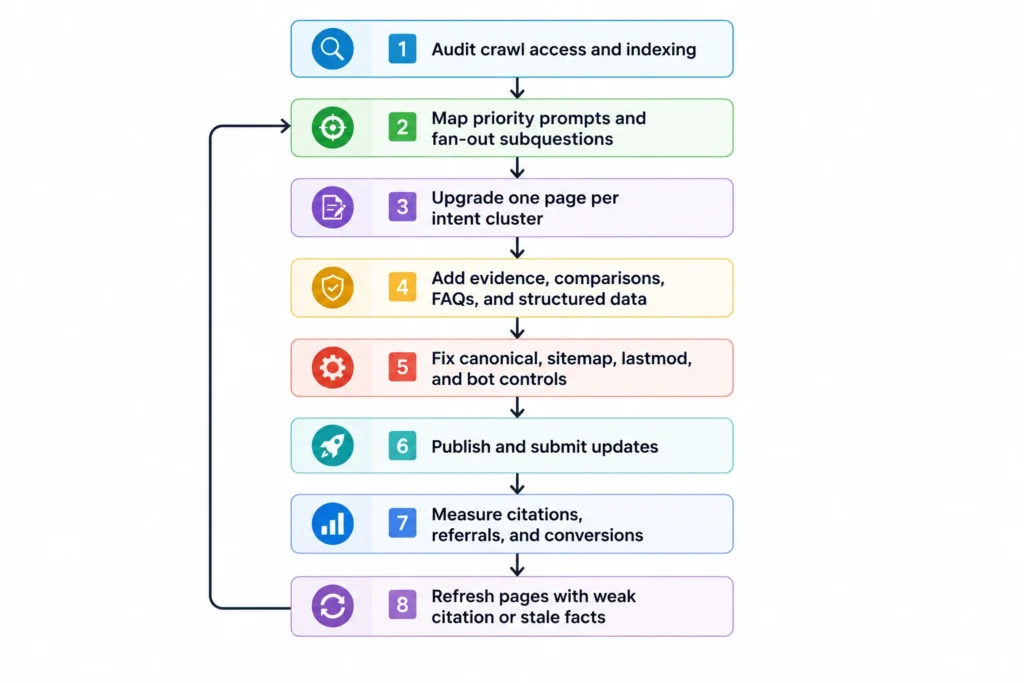
This workflow is grounded in Google’s Search Console reporting, Bing’s AI Performance diagnostics, OpenAI’s referral tracking guidance, and official freshness/indexing guidance from Bing and Google.
A short implementation checklist:
- Allow the relevant bots: `OAI-SearchBot`, Googlebot, Bingbot/IndexNow participation, PerplexityBot, and—if relevant—Claude-SearchBot.
- Consolidate duplicate pages with canonicals and redirects so each intent has one preferred URL.
- Rewrite priority pages into answer-first formats with headings, tables, FAQs, quotes, citations, and original statistics where possible.
- Keep facts fresh and submit updates via sitemap `lastmod` and IndexNow where supported.
- Maintain structured product, organisation, and local business data that matches visible content.
- Track ChatGPT referrals, Bing AI citations, and Google page/query trends together in one reporting layer.
- Refresh pages that attract impressions but few citations, or citations but poor conversions. This is an inference from how Google, Bing, and Adobe describe AI traffic quality and citation visibility.
The point about AI search relying on query decomposition rather than single keyword matching really stood out. A lot of SEO strategies still focus on ranking whole pages, but systems like ChatGPT Search and Google’s AI Overviews seem to reward content that can provide clear, trustworthy evidence at the passage level. It also makes structured data and entity clarity feel much more important than they were in traditional search.