
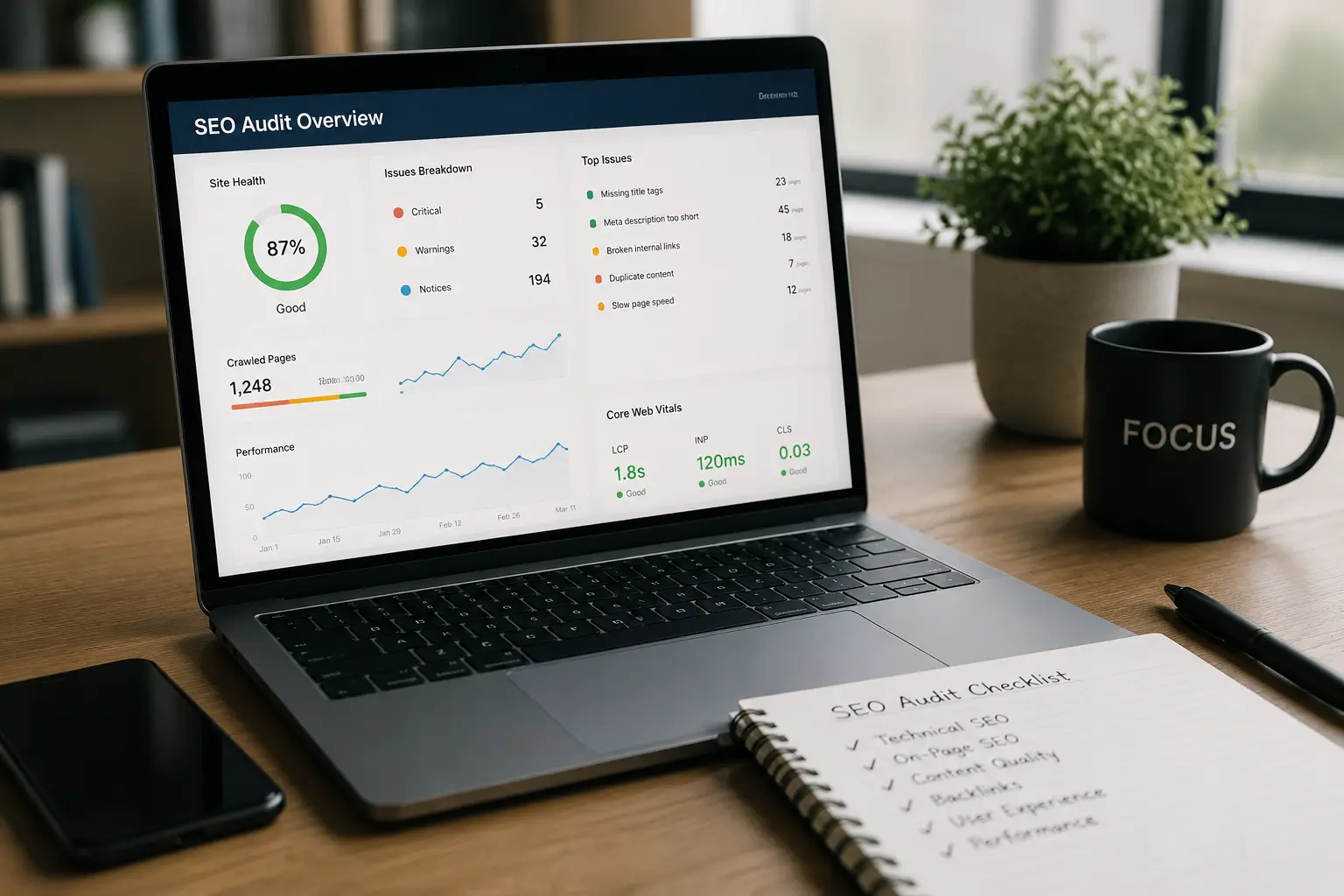

SEO audit benchmarks every US site should know
A modern audit starts with the right yardsticks. Google’s Core Web Vitals are field metrics, so you should judge them using real-user data, not only lab tests. Google also recommends assessing compliance at the 75th percentile, separately for mobile and desktop users.
Core Web Vitals targets for 2026
| Metric | Good target | Needs improvement | Poor | What to use in an audit |
| LCP | ≤ 2.5s | 2.5s–4.0s | > 4.0s | CrUX, Search Console CWV report, PageSpeed Insights, Lighthouse for debugging |
| INP | ≤ 200ms | 200ms–500ms | > 500ms | CrUX, Search Console CWV report, PageSpeed Insights; use TBT in Lighthouse as a lab proxy |
| CLS | ≤ 0.1 | 0.1–0.25 | > 0.25 | CrUX, Search Console CWV report, PageSpeed Insights, Lighthouse |
| TTFB | Track as supporting metric | — | — | Useful diagnostic for slow LCP and server latency |
| TBT | Track as supporting metric | — | — | Best lab proxy for likely INP problems |
These thresholds come from Google’s Web Vitals guidance and Search Console documentation. Google also notes that Core Web Vitals are measured from actual user data in Search Console, while Lighthouse is primarily a debugging tool rather than the ranking input itself.
Mobile versus desktop benchmarks
| Benchmark on the live web in 2025 | Mobile | Desktop | Why it matters in an audit |
| Good overall CWV | 48% | 56% | Passing is still uncommon enough to create a differentiator |
| Good LCP | 62% | 74% | Loading is still the biggest weak spot, especially on mobile |
| Good INP | 77% | 97% | Interaction is mostly solved on desktop, not on mobile |
| Good CLS | 81% | 72% | Mobile often beats desktop on layout stability |
These benchmark figures are ecosystem-wide pass rates from HTTP Archive, not Google’s official thresholds. The threshold itself is the same across devices; what changes is how often real sites meet it. That is why every serious audit needs separate mobile and desktop analysis, even when stakeholders only care about one headline score.
Technical SEO audit checklist for crawlability and indexation
The first duty of an audit is to confirm that the pages you want ranked can actually be crawled, rendered, indexed, and selected as canonical. Search Console’s Page Indexing report shows the indexing status of all URLs Google knows about, and URL Inspection is still the fastest way to validate a single page’s live indexability, canonical selection, and crawl outcome.
Crawl and render accessibility checks
Start by checking that priority URLs return a clean 200 status, are not accidentally blocked, and expose their primary content without user interaction. Google’s AI features guidance and mobile-first documentation are aligned here: pages need to meet Search technical requirements, be indexable with snippets, and keep important content available in textual form. On mobile-first indexing, Google specifically warns against lazy-loading primary content on interaction and against hiding meaningful content on mobile that exists on desktop.
Robots controls are often mishandled in audits. A robots.txt file is for crawl management, not deindexing. Google states plainly that robots.txt is not a mechanism for keeping a page out of Search; if you want removal from Google, use noindex or protect the page. Just as importantly, noindex only works if Google can still access the page. If the URL is blocked by robots.txt, Google may never see the noindex directive.
JavaScript should also be audit-tested, not assumed. Google can process JavaScript, but document-level directives still matter. In its JavaScript SEO guidance, Google shows that robots meta directives can be injected with JavaScript, which is useful, but also a reminder that rendering mistakes can directly change indexability. In practice, your audit should compare raw HTML, rendered HTML, and what URL Inspection reports Googlebot received.
Canonicals, sitemaps, and duplicate control checks
Canonicalisation remains essential because Google chooses one representative URL out of duplicates. If you specify canonicals, audit them for consistency: self-referencing where appropriate, no canonical chains, no canonical targets that are noindex, soft 404, or redirected unintentionally. Google’s canonical documentation makes clear that canonicals are preference signals, not commands, but they are still the cleanest way to consolidate duplicates and reduce cannibalisation.
Sitemaps should be treated as a quality-controlled list of the URLs you actually want indexed. Google recommends including canonical URLs rather than every duplicate variant, and it also says sitemap submission is only a hint, not a guarantee of crawling or indexing. During an audit, that means your XML sitemap should contain only indexable 200 URLs that match your canonical strategy, and it should exclude noindex, parameter junk, and redirecting URLs.
Mobile-first parity checks
For US sites that still maintain mobile/desktop differences, parity is now non-negotiable. Google’s mobile-first guidance says the mobile version should contain the same primary content, equivalent metadata, and the same structured data. It also warns that reduced mobile content can lead to traffic loss because indexing now comes from the mobile version. Your audit should compare template-by-template parity on content blocks, titles, descriptions, images, alt text, and schema.
On-page SEO and content quality audit for rankings and trust
On-page SEO in 2026 is less about squeezing keywords into templates and more about helping systems understand topic, intent, and entity relationships while helping humans decide to click and trust the result. Google Search Essentials still recommends using the words people would use to look for your content in prominent locations such as the title, main heading, alt text, and link text. That remains the simplest on-page audit lens.
Titles, descriptions, headings, internal links, and media
A strong on-page audit checks whether titles are unique, useful, and aligned to intent; whether descriptions are specific to the page; whether URLs are short and descriptive; whether internal anchor text is descriptive; and whether each important page is linked in context from other relevant pages. Google’s snippet documentation also reminds us that snippets are often generated from the page content itself, not always from your meta description, so weak opening paragraphs and vague summaries are still an SEO problem.
Image and video assets now matter more because search is increasingly multimodal. Google says image understanding depends on nearby text, filenames, structured data, and especially alt text. For linked images, alt text also functions as anchor text. That makes media audits more than accessibility work; they are also semantic relevance work. For article pages, use relevant representative images rather than logos, and for product pages, validate image, price, availability, and review markup carefully.
E-E-A-T, authorship, and people-first content audits
Google explicitly says E-E-A-T is not a single ranking factor, so you should not audit it as a mythical checkbox. But Google also says its systems aim to reward original, high-quality content demonstrating expertise, experience, authoritativeness, and trustworthiness, and its rater guidelines overview uses creator identity, reputation, originality, and trust as core quality review criteria. In practice, E-E-A-T is still the best quality lens for auditing whether a page looks credible enough to compete, especially for YMYL topics such as healthcare, finance, insurance, and legal services in the US.
That is why author and publisher transparency deserve a place in every content audit. Google’s article markup guidance recommends author fields, author URLs or sameAs, profile pages, accurate publication and modification dates, and consistent author identity markup. For content where a reader would naturally ask “who wrote this?” or “why should I trust this?”, an audit should verify bylines, author bios, editorial policy, cited sources, and update history.
Google’s people-first content guidance is equally relevant to AI-era audits. It says ranking systems prioritise helpful, reliable information created to benefit people, not content designed mainly to manipulate rankings. Google further clarified that AI-generated content is acceptable when useful, but automation used primarily to manipulate search rankings violates spam policy; in 2024 Google also added spam policies targeting scaled content abuse, expired-domain abuse, and site reputation abuse. Any 2026 audit should therefore look for thin programme pages, templated FAQ spam, mass-produced city pages, and outsourced “parasite SEO” sections that exist mainly to capture search traffic.
Performance, mobile UX, and security audit checks
Performance audits now need two layers: field data for decision-making and lab data for diagnosis. Google’s CrUX API provides aggregated real-user experience data at page and origin level, and the CrUX methodology makes clear that publicly discoverable, indexable pages are eligible for inclusion. Search Console’s Core Web Vitals report then groups URLs using actual user data. Lighthouse remains valuable because it is fast, automated, and good at explaining what to fix, but it is not a substitute for field data.
Field metrics versus debugging metrics
The most common audit mistake is overvaluing a single Lighthouse score. Google’s page experience documentation says there is no single page experience signal, and that trying to achieve a perfect score purely for SEO reasons is often not the best use of time. What matters more is whether your real users are passing CWV thresholds and whether the page feels usable on the devices and networks your audience actually has.
Still, lab metrics are useful if you treat them as leading indicators. Google’s Web Vitals documentation says Lighthouse cannot measure INP directly in a no-user-input lab environment, so Total Blocking Time is the right proxy. Its scoring documentation also shows that Lighthouse 10 weights TBT heavily, alongside LCP and CLS. In a practical audit, that means you should interpret TBT spikes, render-blocking resources, oversized third-party scripts, and DOM bloat as likely interaction problems before CrUX fully reflects them.
Mobile UX, LCP image tuning, HTTPS, and safety
The current web benchmark points to clear fix priorities. HTTP Archive shows LCP is still the hardest main metric to pass at scale, and images remain the dominant LCP element. In 2025, 74% of desktop pages but only 62% of mobile pages achieved good LCP; meanwhile, around 16% to 17% of pages still lazy-load their LCP image, which delays the very content users are waiting for. A good audit therefore checks hero image weight, compression, dimensions, preload or fetchpriority, CDN origin, caching, and whether the hero is being lazily loaded by accident.
Security and usability remain baseline requirements. Google’s page experience documentation still ties good experience to CWV, secure connections, and readable layouts, and its intrusive interstitials guidance warns against overlays that obstruct the main content. Search Console’s URL Inspection guidance also tells site owners to check Manual Actions and Security Issues if a page is missing from results. In practice, a complete audit should include HTTPS status, mixed-content issues, malware or hacked-page checks, aggressive promo overlays, and whether mobile pages make the main content immediately accessible.
AI search readiness and entity SEO audit checks
This is the biggest change in 2026: an SEO audit now needs an answer-engine layer. Google’s AI features documentation says there are no additional technical requirements to appear in AI Overviews or AI Mode beyond being indexed and eligible to show a snippet in Search. It also says Google may use a query fan-out technique to retrieve supporting pages across subtopics and data sources, and that site owners do not need special AI files or custom schema to participate.
Citation signals and fan-out coverage
The implication is important: you should audit whether your site has pages that rank and satisfy not only the primary keyword but also the sub-questions around it. A Search Engine Land summary of Surfer’s 2025 study reported a strong correlation between the number of AI Overview fan-out queries a page ranks for and its likelihood of being cited. Another Search Engine Land report cited BrightEdge data showing that only 0.5% of AI Overview citations went to homepages, which suggests that deep, specific pages are doing most of the citation work.
Ahrefs’ 2026 study adds a second insight: only 38% of AI Overview-cited URLs were also in the top ten for the same query, with large shares coming from positions 11–100 or outside the top 100. That does not mean rankings stopped mattering; it means the citation pool is wider than the blue-link pool, especially when Google is synthesising across related queries. For auditing, the takeaway is clear: specialised pages, original examples, data tables, FAQs, and supporting evidence can win citations even when they are not the headline ranking page.
Bing’s official guidance points in the same direction. In February 2026 Microsoft launched AI Performance in Bing Webmaster Tools, showing total citations, grounding queries, and page-level citation activity across Bing and Copilot surfaces. Bing says these surfaces reward pages with depth, clear structure, evidence-backed claims, freshness, and reduced ambiguity across text, images, and video. That is as close as publishers currently get to an official AI visibility feedback loop.
Structured data, entities, authors, organisations, and local trust
The new result is best thought of as entity SEO, even though Google does not publish it as a separate ranking factor. This is an inference from the documentation, not an official formula: when Google says organisation markup helps disambiguate your company, profile pages help identify people and organisations, article schema should connect to author URLs, and local business markup should describe real business details, it is effectively telling you to make your people, brands, products, and locations machine-legible and consistent. Bing’s AI guidance reinforces that by recommending alignment across formats so the same entities are described consistently.
For US businesses, that means your audit should verify an entity layer across the site: Organization on the home page, author profile pages for writers and reviewers, Article or BlogPosting on editorial pages, Product on ecommerce pages, LocalBusiness on location pages, and consistent sameAs, author URLs, hours, phone numbers, and business identifiers where relevant. Google also says structured data must match visible content, and Bing says up-to-date business and merchant data increase AI visibility for local and commercial answers.
SEO audit workflow, tools, and priority checklist
A robust 2026 workflow joins crawl data, indexing data, field performance, on-page review, schema validation, and AI visibility signals. That is now the minimum needed to explain why a page is not ranking, not getting rich results, or not being cited in AI answers.
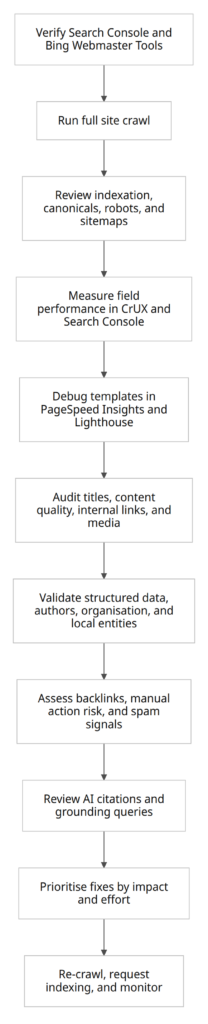
Recommended audit stack
| Audit area | Primary tools | What to inspect |
| Crawl and technical hygiene | Screaming Frog or Ahrefs Site Audit, plus Search Console | Status codes, canonicals, redirects, orphan pages, duplicate titles, broken links |
| Indexation and rendering | Search Console Page Indexing and URL Inspection | Excluded URLs, noindex, crawl blocks, Google-selected canonicals, rendered HTML |
| Real-user performance | CrUX API, Search Console CWV report, PageSpeed Insights | LCP, INP, CLS by device and template |
| Lab debugging | Lighthouse and Chrome DevTools | TBT, render-blocking requests, LCP element, layout shift culprits |
| Structured data | Rich Results Test and Search Console rich-result reports | Errors, warnings, unsupported or mismatched markup |
| Content quality | Manual review plus analytics and GSC queries | Intent match, trust signals, author information, outdated content, weak intros |
| Backlinks and spam risk | Search Console Links report, Ahrefs or Semrush | Referring domains, anchor outliers, toxic patterns, manual action risk |
| AI visibility | Bing Webmaster Tools AI Performance | Citations, cited pages, grounding queries, trend lines |
Want an instant audit? Run your website through the Level AI SEO Auditor. Then validate the findings in Search Console, CrUX, and Bing Webmaster Tools before you prioritise fixes.
Prioritised SEO audit checklist
| Audit step | Priority | Estimated time | What success looks like |
| Verify Search Console and Bing Webmaster Tools ownership | High | 15–30 min | You can access indexing, performance, and AI visibility reports |
| Run a full crawl and export issues | High | 30–90 min | You have one master inventory of URLs and templates |
| Review Page Indexing and URL Inspection for key pages | High | 30–60 min | Priority pages are indexable, canonical, and snippet-eligible |
| Check robots, noindex, canonicals, redirects, and sitemap quality | High | 30–90 min | No contradictory indexation signals |
| Compare mobile and desktop parity on top templates | High | 30–60 min | Same core content, metadata, and schema |
| Measure CWV in field data, then debug in lab | High | 60–120 min | You know which templates fail LCP, INP, or CLS and why |
| Audit titles, descriptions, internal links, and image alt text | Medium | 60–120 min | Every important page is findable and clearly described |
| Audit top landing pages for people-first helpfulness and trust | High | 90–180 min | Strong intros, clear bylines, evidence, freshness, and intent match |
| Validate schema for organisation, article, product, profile, and local pages | Medium | 45–90 min | Markup is valid, visible, and mapped to real entities |
| Review backlink quality and manual action risk | Medium | 30–90 min | No obvious paid-link or spam-link liabilities |
| Review AI citations and grounding queries in Bing | Medium | 30–60 min | You know which pages earn AI references and where gaps exist |
| Re-crawl, request indexing, and monitor conversions, not just clicks | High | Ongoing | Visibility improvements translate into revenue, leads, or engagement |
This sequence is deliberately biased toward what moves visibility fastest: indexability first, page value second, experience third, AI citation-readiness fourth. That reflects both Google’s long-standing audit logic and Bing’s newer AI measurement model.